By Vijay Education
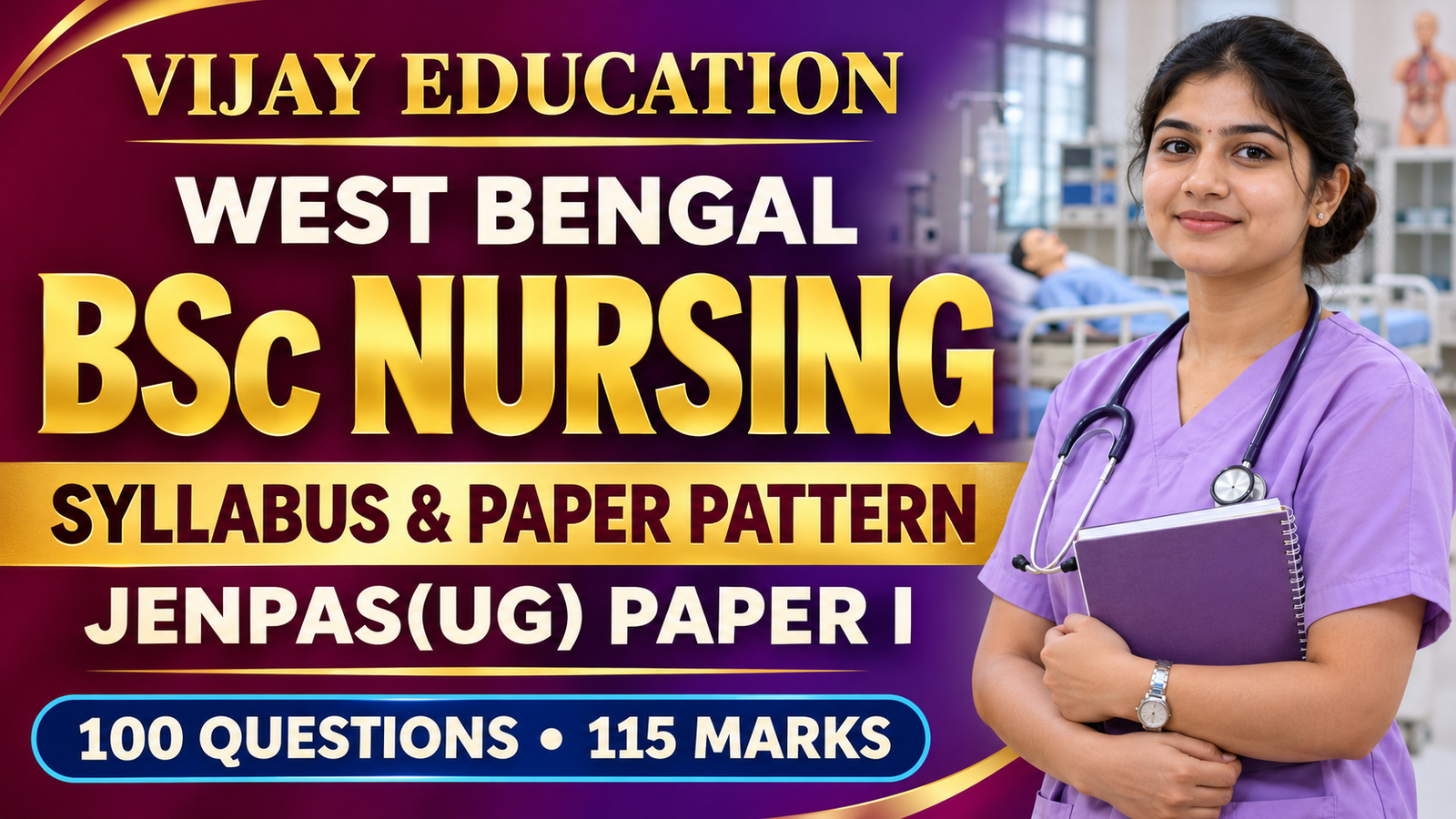
Students applying for West Bengal BSc Nursing through WBJEEB should prepare for JENPAS(UG) Paper I. The published pattern has 100 questions for 115 marks, with 90 minutes to complete the paper. Physics, Chemistry and Biology together carry 75 marks. Basic English and Health Aptitude account for the remaining 40 marks.
JENPAS(UG) Paper I Exam Pattern
Paper I is an OMR-based examination. Questions have four answer options and are available in English and Bengali, except for the Basic English section, which is in English. Physics, Chemistry and Biology include both Category 1 and Category 2 questions.
| Subject | Category 1 questions | Category 2 questions | Total questions | Maximum marks |
|---|---|---|---|---|
| Physics | 15 | 5 | 20 | 25 |
| Chemistry | 15 | 5 | 20 | 25 |
| Biology | 15 | 5 | 20 | 25 |
| Basic English | 20 | 0 | 20 | 20 |
| Health Aptitude | 20 | 0 | 20 | 20 |
| Total | 85 | 15 | 100 | 115 |
JENPAS(UG) Marking Scheme and Negative Marking
| Question type | How marks are awarded |
|---|---|
| Category 1 | Only one option is correct. A correct answer earns +1 mark. A wrong answer or marking more than one option deducts 0.25 mark. An unanswered question earns 0. |
| Category 2 | One or more options may be correct. Marking all correct options earns +2 marks. Partial credit is available if you select some correct options and no wrong option. Selecting any wrong option or leaving the question blank earns 0. |
For example, if a Category 2 question has two correct options and you select only one of them, you earn 1 mark, provided you select no wrong option.
West Bengal BSc Nursing Syllabus and Chapter List
WBJEEB bases Paper I on the Class 11 and Class 12 curriculum of recognised boards. Use the tables below as a chapter-wise preparation checklist for Physics, Chemistry, Biology and Basic English. WBJEEB publishes a separate syllabus for Health Aptitude.
| Subject | Class 11 topics to revise | Class 12 topics to revise |
|---|---|---|
| Physics | Units and Measurements, Kinematics, Laws of Motion, Work, Energy and Power, Rotational Motion, Gravitation, Properties of Matter, Thermodynamics, Oscillations and Waves | Electrostatics, Current Electricity, Magnetism, Electromagnetic Induction, Alternating Current, Ray and Wave Optics, Dual Nature of Radiation and Matter, Atoms and Nuclei, and Semiconductors |
| Chemistry | Mole Concept, Atomic Structure, Periodic Classification, Chemical Bonding, Thermodynamics, Equilibrium, Redox Reactions, Organic Chemistry Basics and Hydrocarbons | Solutions, Electrochemistry, Chemical Kinetics, d- and f-Block Elements, Coordination Compounds, Haloalkanes and Haloarenes, Alcohols, Phenols and Ethers, Aldehydes, Ketones and Carboxylic Acids, Amines, and Biomolecules |
| Biology | Diversity of Living Organisms, Plant and Animal Structure, Cell Structure, Biomolecules, Cell Division, Plant Physiology and Human Physiology | Reproduction in Flowering Plants, Human Reproduction, Reproductive Health, Genetics, Molecular Basis of Inheritance, Evolution, Human Health and Disease, Microbes in Human Welfare, Biotechnology, Ecosystems, and Biodiversity |